En
All English articles are marked under this category
-
Use docker in docker to drive docker from a container Working under windows, sometimes docker slow down. Sometimes you need to access to the MobyVM. With this line:
docker run --rm -ti -v "/var/run/docker.sock:/var/run/docker.sock" -v /:/host docker sh
you run a container which will removed upon exit. This container can access to docker daemon (via the docker in docker image) and has also access to MobyVM under the /host mount point. Keep in mind this container has total access to your windows C: disk too, so be careful! Find the total memory % used by your containers:
Read More -
Some time ago I mentioned the Pyc64 project, a “differently emulated” C/64.
 There’s a much more ambitious project that’s going under pressure, it’s called Commander X 16.
Commander X 16 has been started by David Murray and three other guys.
There’s a much more ambitious project that’s going under pressure, it’s called Commander X 16.
Commander X 16 has been started by David Murray and three other guys.David’s desire was to create an 8-bit computer similar to the C/64 but a little more comfortable to use: for example with 80 columns, but not with too much computing power, so as not to distort its “retro” nature.
Read More -
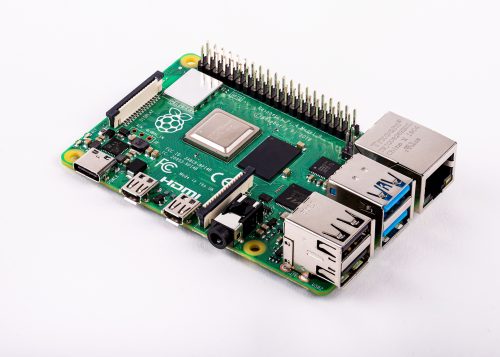
We have a surprise for you today: Raspberry Pi 4 is now on sale, starting at $35!
Source: Raspberry Pi 4 on sale now from $35 - Raspberry PiHere are the highlights:
- A 1.5GHz quad-core 64-bit ARM Cortex-A72 CPU (~3× performance)
- 1GB, 2GB, or 4GB of LPDDR4 SDRAM
- Full-throughput Gigabit Ethernet
- Dual-band 802.11ac wireless networking
- Bluetooth 5.0
- Two USB 3.0 and two USB 2.0 ports
- Dual monitor support, at resolutions up to 4K
- VideoCore VI graphics, supporting OpenGL ES 3.x
- 4Kp60 hardware decode of HEVC video
- Complete compatibility with earlier Raspberry Pi products
Read More -
Source: GraalVMGraalVM is a universal virtual machine for running applications written in JavaScript, Python, Ruby, R, JVM-based languages like Java, Scala, Kotli
 n, Clojure, and LLVM-based languages such as C and C++.GraalVM removes the isolation between programming languages and enables interoperability in a shared runtime. It can run either standalone or in the context of OpenJDK, Node.js, Oracle Database, or MySQL.
Read More -


Ring - Cache interface as a programming language integrationRing provides function-oriented cache interface for various backends.
Repository:
Source: Ring - Cache interface as a programming language integration — Ring 0.7.2 documentation
-
Hi all!
 I decided to write a book called “8-Bit Computers: Retro computer history in the ‘80”.
It is my first book on this topic, so I need you comments & advices!
A small extract is right here for download.
I decided to write a book called “8-Bit Computers: Retro computer history in the ‘80”.
It is my first book on this topic, so I need you comments & advices!
A small extract is right here for download.You will be able to buy the Kindle edition for little as € 0,99 by the end of June.
Read More -
WebAssembly (often shortened to Wasm) is a standard that defines a binary format and a corresponding assembly-like text format for executables used by web pages.
Source: WebAssembly - Wikipedia[….]
WebAssembl
 y code is intended to be run on a portable abstract structured stack machine,[27] which is designed to be faster to parse than JavaScript, as well as faster to execute,[21] and to enable very compact code representation.In March 2017, the WebAssembly Community Group reached consensus on the initial (MVP) binary format
Read More -
Source: NES.css - NES-style CSS Framework
NES.css is NES-style (8bit-like) CSS Framework.#InstallationNES.css is available via either npm or Yarn, or a CDN.Please read README.md.#UsageNES.css only provides components. You will need to define your own layout.
-

In the 1980 comments were used to reduce the “gap” between unstructured code and “rationale” behind the code.
- C/64 Peek and poke where oscure.
- Gosub on function pointed by numbers was bad
- 8-bit systems was tight on command names and so on (think to write a python interpreter in Arduino/bbc:Micro, or look at the memory consumed by the COMMAND STRINGS on C/64 Basic v2)
- C code was not expressive, but good code required little comment, as you can see here
- Comment obscure code -> instead of writing it better
- Comment caching code you will end up to commit breaking production ->instead of having a cache config to disable cache on dev machines
- Comment not working code will end up in production, producing functional breaks -> because you will forget it and commit the bad version
@Comment("Documentation of this class/method/function/closure")
@Fixme("Reason")
@Todo("Why",  deadline=20230423)
Read More -
We have tried the PlayStation Now 7-days trial (after pricing is 15€/Month, 100€/year) Pro:
- Good Game Selection. Also PS3 and PS2 strong sellers are here, like Red Dead Redemption (1) and Bloodbone, Prey, etc
- Seamless experience: the streaming never take a slow down
- Subscription has a 100€/year offer which is quite aggressive. We will see what Apple will be able to do.
- Downloaded game saves are not synced with the streamed one, you need a PlayStation Plus account to get this. It is too bad for a 15€/monthly subscription, isn't it?
- PS Now offer streaming on PC too. But they seems to have trouble with the email link they pass to you to use it (see below). The link is okey from the playstation shop site.

- Some games like Horizon Zero Down, Red Dead Redemption2 are not there, a pity but understandable: Sony cannot destroy its own game market.