En
All English articles are marked under this category
-

The button on the right We are happy to announce a Solar-powered search engine on our web site. The search is integrated with the site, so click on the right upper icon to open the search box, type your words and the search will be far more relevant.
Read More -
After some years in IoT, I tried a bunch of different platform like esp8266 but Arduino remains a must.
Simple reason to choose it for your first (or second :) IoT project:
- Arduino works at 5V and can accept as input voltage 7-12V, but with limit up to 20V (avoid it! :).
This mean you can use a wide range of power supply (4 AA Batteries, 12V transformer from your dead router and so on) - Arduino board provides a 5V regulated output and a 3.3V too for working with a wide range of sensors.
- You got 6 Analog2Digital pins (the A0...A5 pins) with a 0..1024 value resolution. In comparison, esp8266 has only one pin with less resolution.
- It is completly open source, so you can find easily cheap clones like this one at less then 10 euros.
- The ATmega328P chip inside Arduino provide I2C and SPI communication which means you can easily work with other chip.
You can even program an Arduino to be an I2C client to other Arduinos making a small set of complex circuits.
For instance, the C/64 SID chip emulator can be compiled to act like a I2C slave and another Arduino can program it like...a SID chip - Did I talk about the real time operating system, written by an italian guy?.... I was able to use it to build a small "Egg box Lamp".
- Arduino works at 5V and can accept as input voltage 7-12V, but with limit up to 20V (avoid it! :).
-
For a complete description see https://www.codeproject.com/Articles/33052/Visual-Representation-of-SQL-Joins
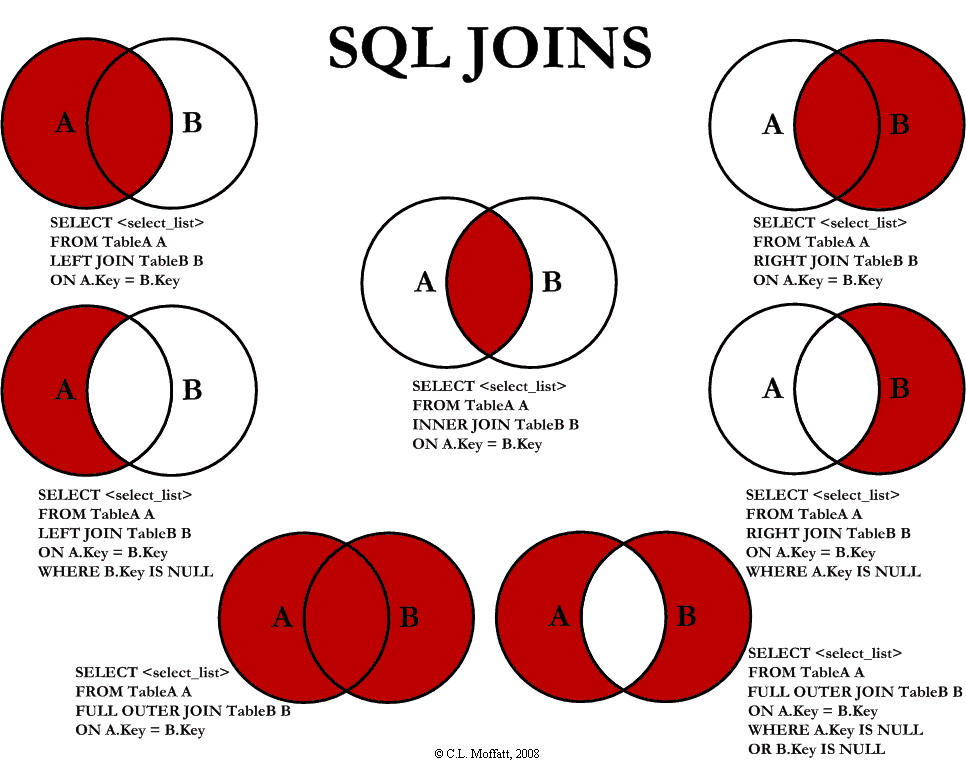
All the Join you want -

The Sqlite Oracle Compatibility Functions is an experimental compatibility layer for SQLite vs Oracle, written in Python 3.
It aims to provide a minimal compatibility with Oracle. The need was having some regular expression functions, and I do not like to work with risky C code, like this university project did
Read More -

A very useful friend to make a elisp function starting from your….last command
C-x ESC ESC (translated from C-x <escape> <escape>) runs the command repeat-complex-command (found in global-map), which is an interactive compiled Lisp function in ‘simple.el’.
It is bound to <again>, <redo>, C-x M-:, C-x M-ESC.
Read More -

To understand Angular 4, after the “Hero” tutorial you should start from the Template syntax.
We highlighted some statement in red below:
Data direction Syntax Type One-way from data source to view target \{\{expression\}\} [target]="expression" bind-target="expression" Interpolation Property Attribute Class Style One-way from view target to data source (target)="statement" on-target="statement" Event Two-way [(target)]="expression" bindon-target="expression" Two-way Binding types other than interpolation have a target name to the left of the equal sign, either surrounded by punctuation (
[],()) or preceded by a prefix (bind-,on-,bindon-).The target name is the name of a property. It may look like the name of an attribute but it never is. To appreciate the difference, you must develop a new way to think about template HTML.
Read More -
On a Milan advertising panel, after scratching the surface for summer maintenance, a very old advertising (older than me!) come to life: